
There is a street in McKinney where you need a city board’s permission to change your fence. Eleven minutes west, there’s a subdivision where the HOA has an opinion about the color of your driveway. And across most of the northern half of the city, the concrete went down after 2015 and nobody is touching it for a decade.
Same city. Same three slots in the Map Pack. Three completely different sales conversations.
That’s the part generic marketing advice can’t help you with, and it’s the reason a playbook that works in Frisco quietly fails here.
Concrete contractors in McKinney, TX compete in three separate markets inside one city. A small pre-1930 historic overlay where exterior work — fencing explicitly included — requires a Certificate of Appropriateness from the city. A large HOA belt built from the mid-1980s onward, now reaching replacement age. And a post-2000 majority where demand is additive rather than replacement. Ranking in McKinney means one optimized Google Business Profile, separate service pages per layer, and consistent citations — aimed at three different searches, not one.
Why most concrete contractors in McKinney stay invisible on Google
McKinney, Texas is not short of homeowners who need concrete. The city sits around 243,500 people and is still adding roughly 3% a year. It’s the Collin County seat, the county’s third-largest city after Plano and Frisco, and the Census Bureau ranked it the fourth fastest-growing large city in the country from 2010 to 2019.
Look at the longer arc and the number that matters becomes obvious. McKinney had 54,369 residents in 2000. It had 195,308 at the 2020 census. It has around 243,500 now. Roughly four out of five people living in McKinney today arrived after the year 2000.
So demand isn’t the problem. The problem is that when a homeowner near Louisiana Street pulls out their phone and a homeowner in Craig Ranch pulls out theirs, they are typing different things, they need different work, and only three businesses appear above the map for either of them.
Here’s what I see going wrong specifically in this city. McKinney grew so fast that a lot of its concrete contractors arrived during the growth and learned the market as a new-build market — because for the years they’ve been here, that’s mostly what it was. They optimized for patios and pool decks, which is correct for two-thirds of McKinney and leaves the oldest, most profitable, least competitive third of the city completely unserved.
Nobody is fighting you for that third. I’ll come back to why.
The three systems that decide whether McKinney homeowners find you
Google’s local results — the Map Pack, the organic listings beneath it, and the AI summaries now sitting above both — run on a set of signals that reinforce each other. The contractors who show up here consistently are running three things their competitors aren’t.
Your Google Business Profile. This is what decides whether you enter the Map Pack at all, and increasingly whether an AI answer names you when somebody asks who does good concrete work in McKinney. Most contractor profiles in this city are maybe a third finished: one category, a phone number, a dozen photos from a job in 2022. The parts that compound are the parts nobody does — a complete service list, weekly posts, steady review velocity, service areas drawn the way people actually search, and photos that match what your buyer is actually shopping for.
Your website. Not a redesign. Structure. Google needs pages that state what you do and where, and a homepage reading “we do concrete” gives it nothing to work with. In a city split three ways, a single page also gives Google no reason to associate you with any particular part of McKinney. It defaults to the ZIP code on your profile and you disappear everywhere else.
Your citations. Every other place online that lists your name, address, and phone number. They need to match each other exactly. Most contractors have never checked, and a surprising number have an old phone number from a line they dropped years ago still circulating on directory sites.
None of the three does much alone. A trusted profile lifts your site. A structured site gives your profile something to point at. Matching citations tell Google the two belong to one real business standing in one real place.
What McKinney-specific searches actually look like
Nobody in McKinney searches “premier concrete solutions North Texas.” They search “concrete patio mckinney tx” from the back yard they’re standing in, or they search “concrete contractor near me” from a driveway.
The searches here cluster into five groups, and the fifth is the interesting one.
Service plus city. “Concrete driveway mckinney tx,” “concrete patio mckinney,” “stamped concrete mckinney tx.” The obvious cluster, and the crowded one.
Service plus near me. GPS-anchored rather than city-anchored, and it’s what most of your customers actually type. Proximity is one of the things Google weighs, so where your pin sits changes who sees you. A contractor pinned near the downtown square is not the default answer for someone standing in a subdivision on the far west side of the city.
Replacement language. “Driveway replacement mckinney,” “concrete repair mckinney,” “concrete tearout,” “concrete removal mckinney tx.” Thin in Frisco. Not thin here, because a large slice of McKinney’s housing stock is now old enough to need it.
Adjacent cities. McKinney borders a lot of places people search separately: Allen, Frisco, Prosper, Melissa, Princeton, Fairview, and Anna. If your service area genuinely covers them, those are additional searches you can win with pages you don’t currently have.
Permitted and historic work. “Historic district concrete mckinney,” “certificate of appropriateness fence mckinney,” “historic home driveway mckinney.” Small volume. Almost zero competition. High margin. This is the cluster the rest of the article is about.
There’s also a commercial market forming that nobody local is targeting. McKinney National Airport’s passenger terminal is on schedule for completion in late 2026, funded through roughly $22.4 million approved by the McKinney Economic Development Corporation in May 2025, a $7.4 million budget amendment, and about $20.8 million in construction contracts. Avelo Airlines officials toured the building in February. A commercial terminal means apron, sidewalk, ADA ramp, and parking work now, and then the retail and restaurant pads that follow an airport for the next decade. Add the county seat’s own steady municipal flatwork. Searches like “commercial concrete contractor mckinney” are low-volume and high-ticket, and I can count the local profiles carrying a commercial category on one hand.
What actually works in McKinney: the permit layer nobody is marketing
I run Lucent Media Solutions, a productized local SEO shop for concrete contractors across Dallas–Fort Worth, and I operate a portfolio of local-rank properties in this region. That means I read this search landscape from inside it rather than from a keyword export.
Here’s the thing about McKinney that no other city in this series has.
During the 1980s, McKinney’s City Council passed ordinances establishing two historic districts. The residential one is genuinely old by North Texas standards — the National Register listing covers 115 structures, of which 91 contribute to the district’s historic character, and the majority were built between 1895 and 1930. It runs roughly inside W. Louisiana, N. Oak, N. Benge, and W. Lamar, northwest of the downtown square. Queen Anne, Classical Revival, Prairie School, bungalows, Tudor Revival. Actual pre-war housing.
Inside that overlay, exterior work goes through a Certificate of Appropriateness. The city’s own list includes replacing windows, siding, and exterior doors, removing historic trim or masonry, and adding or removing shutters, porches, railings, chimneys, fencing, and signage. Fencing is spelled out in the plainest terms the city uses anywhere: all new fences, or changes to the style, size, or location of a fence, require a Certificate of Appropriateness.
Applications go to the Historic Preservation Advisory Board, which meets once a month. To give you a sense of the granularity — the March 2026 agenda included a COA request to demolish a detached shed at 1105 W. Lamar. A shed went to a board.
Now the part I can’t tell you, which is exactly why this is an opportunity.
The city does not publish whether driveways, walkways, or flatwork paving fall inside COA scope. I looked. Fences are explicit. Paving isn’t addressed either way. So a homeowner in that district who wants their 1912 bungalow’s driveway replaced has no way to find the answer online, which means they have to call somebody and ask.
That somebody should be you.
Build one page. Call it what people search: concrete work in McKinney’s historic district and what needs a Certificate of Appropriateness. Before you write it, call the Historic Preservation Office at 972-547-2000, ask specifically about driveway replacement, walkway repours, and retaining walls inside the overlay, and get the answer clearly enough that you’d stake a job on it. Then publish it, dated, with the caveat that scope decisions sit with the city.
Four things happen. You own a search query with real purchase intent and effectively no competitors. You get cited by AI answers, because you’ll be the only page on the internet that plainly answers the question. You become the contractor the neighborhood recommends, in a district of ninety-odd houses where recommendation travels over a fence. And you get a legitimate reason to charge for permit navigation — because the board meets monthly, which means a homeowner who hires the contractor who guessed wrong loses four weeks, not four days.
That last point is the actual sales argument. A crew driving up from Dallas cannot fake it.
Two honest caveats, because I’d rather you hear them from me. The volume on this cluster is small — this is not a page that transforms your call log. And never guess at scope in front of a client; in a district where a shed needs approval, guessing is how you end up removing work you already poured. The value here is being the one concrete contractor in McKinney who knows, and can prove it in writing.
The three-layer keyword split, and why one page can’t serve all three
Zoom back out. McKinney is three markets stacked in one city, and each one wants a different page.
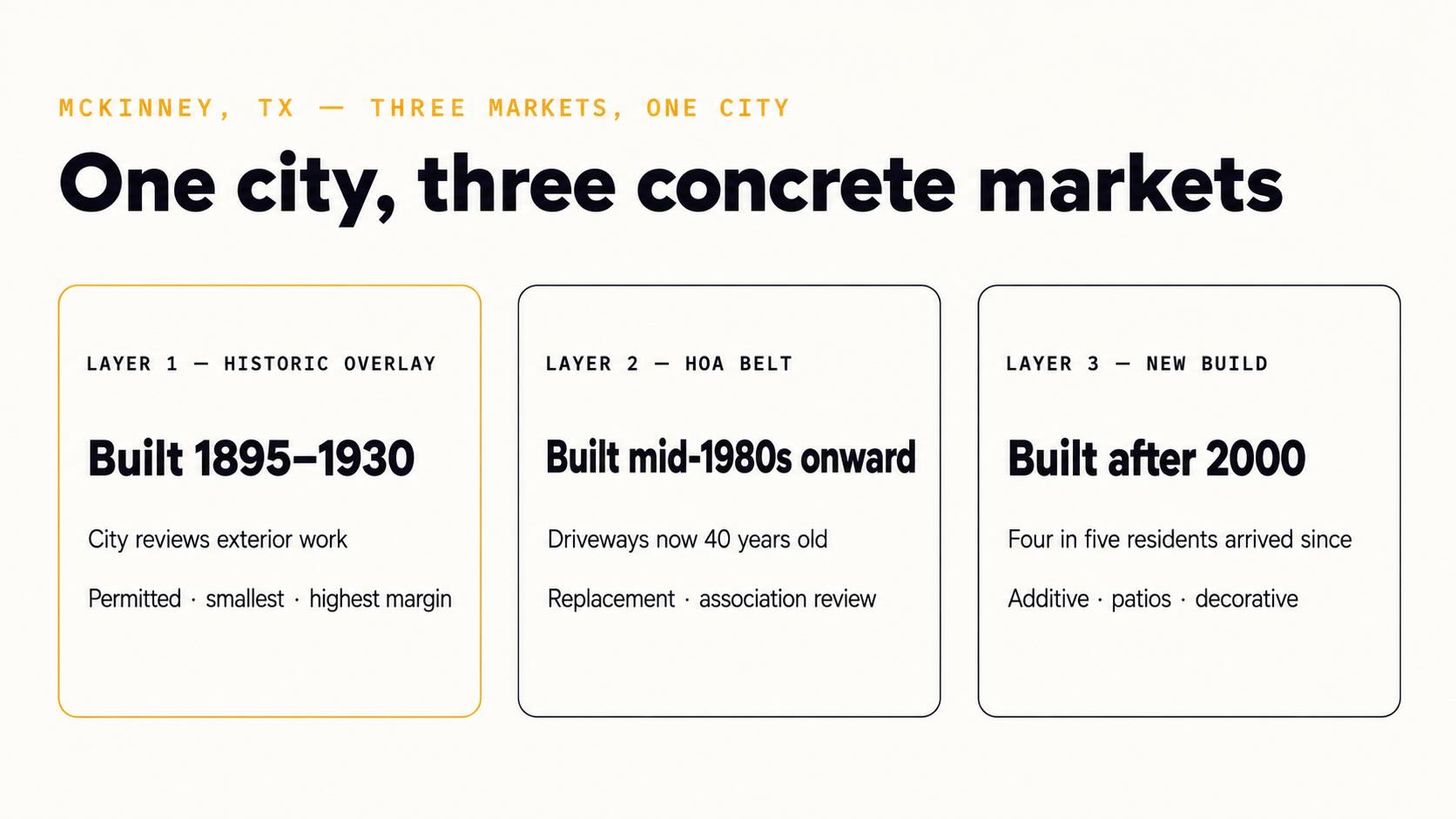
The three concrete markets inside McKinney, and the search intent each one produces.
Layer one — the historic overlay. Pre-1930 stock, permitted work, small footprint, highest margin, least competition. Covered above.
Layer two — the HOA belt. Stonebridge Ranch is a 6,000-acre master-planned community where building commenced in the mid-1980s and more than 2,000 homes have gone up, governed by a community association. Do the arithmetic on the earliest phases: those driveways are around forty years old. North Texas sits on expansive clay that swells and shrinks and moves whatever you poured on top of it, and forty years of that is a driveway at the end of its life. This is a replacement market — the same economics that drive the work in Carrollton, where 1970s and 80s housing stock produces a steady drip of tearout, and in the older eastern half of Plano. The difference in Stonebridge is the association layer on top. Architectural standards mean the homeowner’s real question isn’t “how much” but “will this get approved.” A contractor who mentions the association’s review in the first two minutes of a call sounds like a local. Everyone else sounds like a bid. And the local soil that does this to driveways is the same soil behind drainage and foundation problems — if you handle those too, put it somewhere Google can read it.
Layer three — the post-2000 majority. Craig Ranch alone is a 2,200-acre greenfield master-planned development that entered the regional pipeline in the 2000–2001 planning cycle, and it’s one of many. With four in five current residents having arrived since 2000, most concrete in McKinney is young and structurally fine. Demand here is additive — patios, pool decks, driveway extensions, third-car pads, stamped, stained, and decorative work on a slab that doesn’t need replacing. This is Frisco’s market, and the same rules apply: your photo library should be finished patios in daylight, not demo shots.
One page titled “Concrete Services” loses in all three. It tells Google nothing about which McKinney you serve, and it tells a homeowner in the historic district that you’ve never dealt with their situation. Three pages, each written for one layer, each with photos from that layer, is the whole play. It’s also a weekend of work.
Then the adjacency pages: Allen, Frisco, Prosper, Melissa, Princeton, Fairview, Anna. Only build the ones you’d actually drive to.
What “doing this yourself” actually costs
I’d rather be straight about the time than pretend any of this is easy.
If you run a small crew and handle all three systems yourself, expect five to ten hours of setup to get the profile configured properly, the site restructured, and citations submitted. Then two to four hours a week, ongoing, for posts, review chasing, responses, and content. And six to twelve months before rankings move in a way you’d notice in your bank account, because local search compounds slowly and there is no version of this that doesn’t.
For most contractors that math doesn’t close. You finish a ten-hour pour in August in Texas and the last thing happening that evening is a Google post. That’s why people hire it out.
If you go that route, don’t take a vendor’s word for anything. I wrote out the nine questions to ask before you hire an SEO company, including the red flags that should end a sales call early, and it’s built to be used against me too. For the money side — what every channel actually costs, retainer tiers, and what belongs in each — there’s a full breakdown of concrete contractor marketing costs in 2026. Read both before your first call, not after.
How we work with concrete contractors at Lucent Media Solutions
Now the disclosure, since the framework above is yours regardless.
We run a productized local SEO and Google Business Profile service for concrete contractors across DFW, McKinney included. One plan, called Spark. It’s $597/month, month-to-month, no setup fee, and the scope is published rather than quoted:
- Complete GBP optimization and ongoing management — posts, photos, categories, services
- Review collection and response management
- Local citation building and maintenance
- One SEO article per month, published to your site
- Monthly reporting on rankings, calls, and direction requests
We qualify before taking anyone on. You should be doing at least $750k a year, tracking customers somewhere even if it’s a spreadsheet, and already spending something on marketing. If those aren’t true, we’ll tell you to fix operations first and come back.
Free GBP audit (no sales call required)
If you want to know where you stand before spending anything, I’ll record a 5 to 10 minute video walking through your Google Business Profile and naming the three things costing you the most leads. No call, no pitch, no email list.
Fill out the short intake form with your business name, website, and city. The video comes back within five business days, and it’s yours to keep whether we ever speak again or not.
For a McKinney contractor, the first thing I’ll probably tell you is which of the three layers your profile is currently aimed at, and which one you’re leaving on the table.
About the author
I’m Aziz Shaik, founder of Lucent Media Solutions, based in Plano — about twenty minutes from the McKinney square. My background is software engineering. I spent years building systems that had to actually work before I started applying the same thinking to local search.
What makes Lucent different is that I don’t only consult on Google Business Profiles. I operate a portfolio of them across DFW, mostly concrete and fence. Every recommendation I give a client got tested first on a property I own, in the market they compete in. When something works I know why. When it doesn’t, I find out before I bill anyone.
Connect with me on LinkedIn.