
You are about to hand someone $600 to $3,000 a month to do work you cannot see, in a system you do not control, with results that will not show up for a season. That is an uncomfortable purchase. It’s made worse by the fact that almost every page you’ll read while researching it was written by someone trying to win the sale.
Including this one. I’ll get that out of the way early.
Most “best SEO company for concrete contractors” lists are published by SEO agencies that rank themselves first. Skip the lists and vet the vendor directly. Ask for concrete-contractor Google Business Profiles they manage right now, a monthly price published on their website, and a month-to-month agreement. Google’s own guidance states that no one can guarantee a #1 ranking, so treat a ranking guarantee as disqualifying. Expect 60 to 90 days for early Google Business Profile movement, and 4 to 12 months for competitive Map Pack positions.
Why every “best concrete SEO company” list ranks the company that wrote it
Go try it. Search the phrase, open the first three or four listicles, and scroll to the bottom of each. Find out who published it. Then look at who landed in the number one slot.
It’s them. Nearly every time.
This isn’t a conspiracy, and it isn’t even against any rule. It’s just how those pages get made. An agency writes a roundup of “the best agencies,” installs itself at the top, then fills positions two through seven with real competitors so the thing reads like journalism. Then it ranks for the exact phrase every prospect types in the week before they buy. It’s a sales page wearing a lab coat.
I’m not going to write one. I sell this service — I run Lucent Media Solutions, a productized local SEO shop for concrete contractors across Dallas–Fort Worth — so a list from me would carry the identical defect. You’d be right to discount it.
What I can give you is the vetting process I’d use if I were sitting on your side of the table. It works on me, too. Run it on Lucent. If we come up short, don’t hire us.
The three things an SEO company actually does for you
Before you can judge a vendor, you need to know what the job is. For a concrete contractor it’s narrower than most agencies let on.
Your Google Business Profile. This is the asset. It decides whether you appear in the Map Pack — the three businesses with the map above them — and, increasingly, whether an AI answer names you when someone asks who the best concrete contractor in town is. The work is categories, services, photos, posts, review velocity, and a service area drawn the way people actually search. It is unglamorous and it compounds.
Your website. Not a redesign. Structure. Google needs pages that say what you do and where you do it, and a homepage that says “we do concrete” gives it nothing to rank. Service pages, city pages, real project photos.
Your citations. The other places on the internet that list your name, address, and phone. They need to match each other to the character. Most contractors have never audited this and have two or three old phone numbers still circulating.
Everything else an agency sells sits on top of those three. If a proposal spends more time on social media strategy than on any of them, you’re being sold the fun part instead of the part that rings the phone.
One current wrinkle worth knowing before you take a sales call. A lot of vendors are now selling “GEO” or “AI search optimization” as a separate line item, priced separately, because AI answers started eating the top of the results page. Here’s my take, and you’re free to disagree with it: for a local trade business, it’s the same work. The things that get you named in an AI answer are a well-structured profile, content that answers real questions plainly, a real author attached to it, and consistent information across the web. That’s the list above. If someone quotes you an extra $500 a month for a GEO package, ask what’s in it that isn’t already in the SEO package. I’ve yet to hear an answer that survives the question.
Specialist vs. generalist: what “we do contractor SEO” usually means
Every agency competing for your search says it specializes in contractors. Most mean they’ve had a few.
The difference surfaces in exactly one place: whether they can tell you something about your market that you didn’t already know.
Here’s the test case. The keyword strategy that wins in one DFW suburb actively loses in the one up the road. In Carrollton, the housing stock runs to the 1970s and 80s, so the money sits in tearout and replacement work. Twenty minutes north in Frisco, almost nothing is old enough to replace — the demand is patios, pool decks, and decorative pours on slabs that are perfectly sound. Plano has both, split roughly east and west down the middle of the city. McKinney stacks three layers, including a historic overlay where the city itself reviews exterior work. Same metro, four incompatible keyword strategies.
A generalist sells all three of those contractors the same page titled “Concrete Services” and reports on impressions.
So ask it directly: what’s different about how my customers search compared to a contractor an hour away? You don’t need them to be right. You need them to have an answer that isn’t a brochure.
The nine questions to ask before you sign
Print these. Ask every vendor the same nine and compare the answers side by side, including mine.
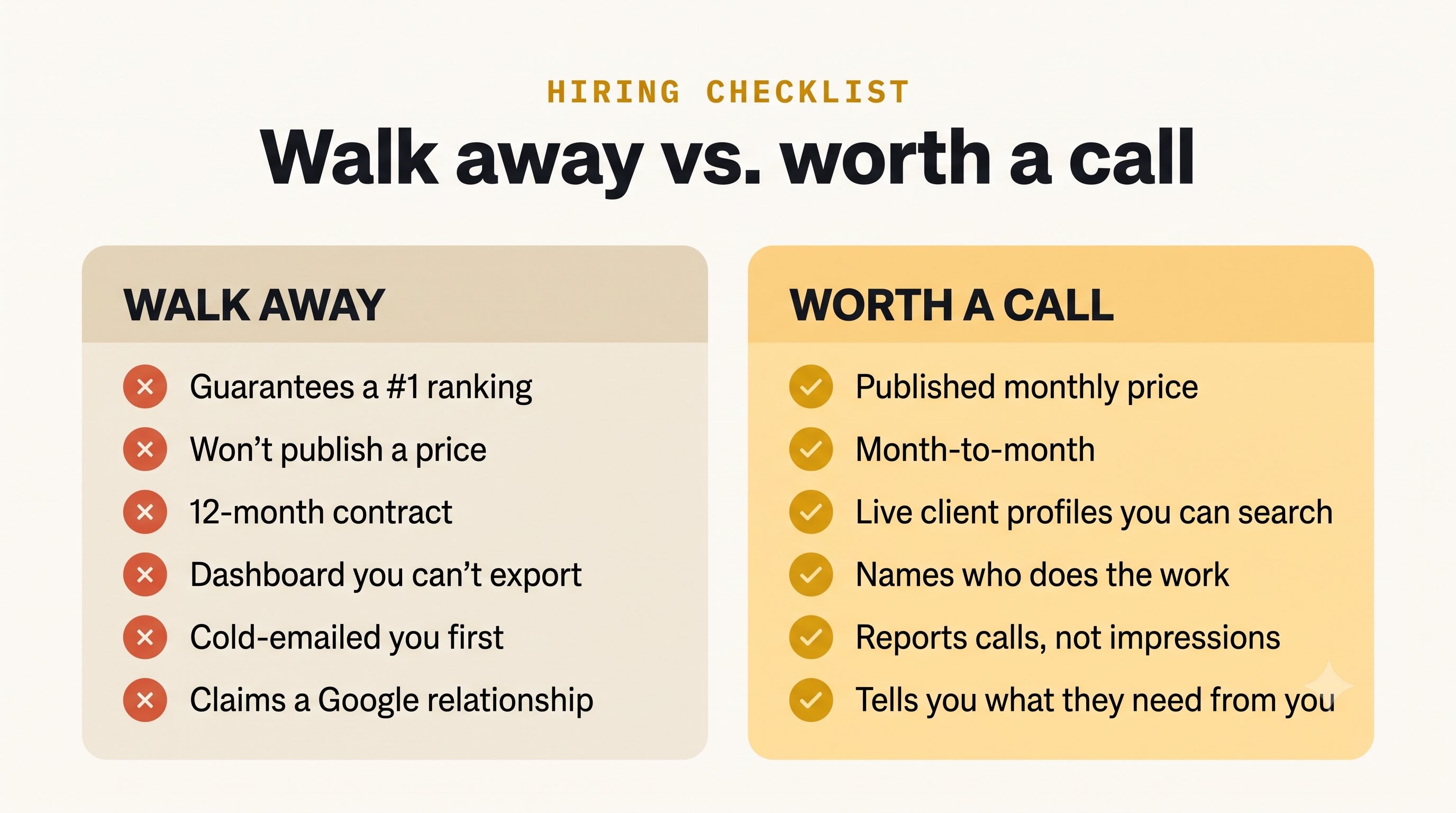
1. Can you show me Google Business Profiles you currently manage for concrete contractors? Not logos. Not “hundreds of happy clients.” Profiles, live, that I can search myself. If they can’t, they’re learning your trade on your money.
2. What’s the monthly price, and is it published on your website? A price that changes based on how much they think you can pay isn’t a price, it’s a negotiation.
3. Month-to-month, or a term? A twelve-month contract means the vendor’s plan for keeping you is legal, not operational.
4. Who actually does the work? The person on the call is frequently not the person doing the posts. Ask for the name.
5. If I leave, what do I keep? The GBP is yours. But the website, the content, the citations, and the call-tracking number are all things an agency can build inside its own account and take with it.
6. What happens in the first 30 days, specifically? A good answer is boring and itemized. A bad answer is the word “strategy.”
7. How do you report, and on what? Impressions and “keywords improved” are decoration. Calls, direction requests, form fills, and Map Pack position for terms that actually convert are the report.
8. What do you need from me every month? If the answer is “nothing,” they aren’t getting job photos, and their posts will be stock images of somebody else’s driveway.
9. Who else in my market do you work with? If they’re running two concrete contractors in the same city, one of you is the hedge.
Nobody will ace all nine. I wouldn’t. What you’re listening for is whether the answers are specific or whether they slide.
Pricing models and what each one quietly incentivizes
Every pricing model is a set of instructions to your vendor about what to care about. Read them that way.
Flat monthly retainer. You know the number, they know the scope, and the incentive is to keep you happy at the lowest delivery cost. The risk is coasting. The defense is a defined, written scope.
Percentage of ad spend. Usually 15 to 20%. The vendor’s income rises when your ad spend rises. That’s not automatically corrupt, but it means nobody in the room is paid to tell you to spend less.
Per-lead. Feels safest and usually isn’t. Whoever defines “lead” controls the invoice, and a wrong number dialed for thirty seconds has ended up on plenty of them. Ask what disqualifies a lead before you agree.
Performance or contingency. Rare, and the fine print is the product. The guaranteed keyword tends to be one nobody searches — rank theater that generates a reportable win while your phone stays quiet.
I’ve written the full channel-by-channel breakdown of what concrete contractor marketing actually costs in 2026, including retainer tiers and what belongs in each. Read it before your first sales call, not after.
Red flags
Google publishes its own guidance on hiring an SEO, and it is blunter than anything an agency will tell you. Two lines from it are worth memorizing: no one can guarantee a #1 ranking on Google, and be wary of anyone claiming a special relationship with Google or a priority submission. Google also flags secrecy — a company that won’t plainly explain what it’s going to do.
Add these from my side of the industry:
- A ranking guarantee. Disqualifying on its own. It means worthless keywords, black-hat tactics, or an escape clause you haven’t found yet.
- No published price. In this industry, a hidden price usually means the price depends on you.
- A proprietary dashboard you can’t export. Your data, their hostage.
- Cold outreach. The unsolicited “I noticed your site isn’t ranking” email is the oldest tell there is. Google warns about it explicitly.
- Case studies with no verifiable business. A screenshot of a traffic graph is a picture of a graph.
- Selling you a redesign first. Sometimes legitimate. Often the highest-margin thing they sell.
How to verify any agency’s claims yourself in 20 minutes
You don’t need software for this, and you don’t need to take anyone’s word.
Search their own money keyword. An agency selling concrete contractor SEO should rank for concrete contractor SEO. If they’re invisible for the thing they sell, that’s information.
Pull up a client they named. Search that business plus its city on your phone. Are they in the Map Pack? How many reviews, and when did the last few land? When was the last GBP post? Five minutes tells you whether anyone is actually working the account.
Check their own Google Business Profile. An agency without a maintained profile is selling you something it doesn’t do.
Read their content. Not for quality — for specificity. Could this exact article have been published by an agency in another state with the city name swapped? If yes, that’s what your pages will read like.
Look at review dates, not review counts. Forty reviews from 2021 and nothing since is a business that stopped.
What months 1–3, 4–6, and 7–12 should actually look like
If a vendor won’t give you a timeline, here’s the one to hold them to. This is roughly what I see across the profiles I run.
Months 1–3. Profile rebuilt, categories and services corrected, citations submitted and cleaned, posting cadence started, review requests going out. Rankings barely move. This is the part where contractors quit. Nothing is wrong; the work just hasn’t compounded yet. You should see early movement on low-competition terms around day 60 to 90.
Months 4–6. Map Pack positions start shifting on real terms. Call volume becomes noticeably different rather than statistically different. Content is indexed and beginning to rank.
Months 7–12. Competitive terms land. The asset is built and maintenance is cheaper than construction.
If your cash flow can’t survive months one through three, be honest about that now and start with ads instead. SEO is the cheaper lead, eventually. Eventually is doing real work in that sentence.
And if month six arrives and nothing has moved? Ask for the grid. Not a ranking report from the agency’s own tool — a grid-based scan showing where you rank across your service area, because a single ranking number is measured from one point on a map and tells you almost nothing. If positions genuinely haven’t shifted anywhere on that grid in six months of work, one of three things is true: the market is more competitive than they scoped, the work isn’t being done, or your business has a problem SEO can’t fix, like eleven reviews and no photos. A vendor worth keeping will tell you which one it is, even when it’s the second. That’s the conversation that separates them, and it’s the reason a month-to-month agreement matters more than any guarantee.
How we work with concrete contractors at Lucent Media Solutions
Now the disclosure, since the framework above is yours either way.
We run a productized local SEO and Google Business Profile service for concrete contractors in DFW. One plan, called Spark. It’s $597/month, month-to-month, no setup fee, and the scope is published rather than quoted:
- Complete GBP optimization and ongoing management — posts, photos, categories, services
- Review collection and response management
- Local citation building and maintenance
- One SEO article per month, published to your site
- Monthly reporting on rankings, calls, and direction requests
We qualify before taking anyone on. You should be doing at least $750k a year, tracking customers somewhere even if it’s a spreadsheet, and already spending something on marketing. If those aren’t true, we’ll tell you to fix operations first.
Run the nine questions on us. That’s genuinely the point of publishing them.
Free GBP audit (no sales call required)
If you want to know where you stand before spending anything, I’ll record a 5 to 10 minute video walking through your Google Business Profile and naming the three things costing you the most leads. No call, no pitch, no email list.
Fill out the short intake form with your business name, website, and city. The video comes back within five business days, and it’s yours to keep whether we ever speak again or not.
About the author
I’m Aziz Shaik, founder of Lucent Media Solutions, based in Plano. My background is software engineering — I spent years building systems that had to work before I started applying the same thinking to local search.
What makes Lucent different is that I don’t only consult on Google Business Profiles. I operate a portfolio of them across DFW, mostly concrete and fence. Every recommendation I give a client got tested first on a property I own, in the market they compete in. When something works I know why. When it doesn’t, I find out before I bill anyone.
That’s also why I’m comfortable publishing a vetting framework that can be used against me. If the process points somewhere else, you should go there.
Connect with me on LinkedIn.